

AI in Healthcare Market Expected to Reach US$ 1078.42 Billion by 2034 at CAGR of 45.3% | The Insight Partners
Coverage - By Component (Software, Hardware, and Services), Deployment (Cloud and On Premises), Organization Size (Large Enterprises and SMEs), and Geography (North America, Europe, Asia Pacific, Middle East and Africa, and South America)
New York, June 15, 2026 (GLOBE NEWSWIRE) -- The Insight Partners, published its latest market intelligence report on the Global AI in Healthcare Market . The study finds the market, valued at US$ 39.55 billion in 2025, is projected to reach US$ 1,078.42 billion by 2034, registering a compound annual growth rate (CAGR) of 45.3% over the 2025 - 2034 forecast period. Research draws on primary interviews with C-suite executives, OEM engineers, procurement heads, and policy analysts across more than 15 countries, augmented by proprietary databases and third-party validation.
Market Overview
The AI in healthcare market is experiencing rapid expansion driven by increasing demand for efficient diagnostics, personalized treatment, and operational automation. Healthcare systems globally are under pressure from rising patient loads, workforce shortages, and cost constraints, making AI-powered solutions highly attractive. Technologies such as machine learning, natural language processing, and computer vision are being widely adopted for medical imaging, drug discovery, and clinical decision support. Hospitals and healthcare providers are integrating AI tools to improve accuracy, reduce human error, and accelerate workflows. Additionally, the growing digitization of health records and availability of big data are further accelerating AI adoption across healthcare ecosystems.
On the market side, investment activity and innovation are strong, with startups and established technology firms competing to develop scalable healthcare AI platforms. Regulatory support in several regions is gradually improving, although concerns around data privacy, algorithm transparency, and clinical validation remain key challenges. The market is also shifting toward value-based care, where AI helps optimize outcomes while reducing costs. Emerging applications in remote patient monitoring, virtual health assistants, and predictive analytics are expanding the scope of adoption beyond hospitals into home care and telehealth. Overall, the sector is evolving from experimental pilots to mainstream clinical and operational deployment.
latest research on the AI in Healthcare Market, covering market size forecasts, growth drivers, regulatory trends, and competitive insights.
You may access the Sample document here: https://www.theinsightpartners.com/sample/TIPRE00042231/
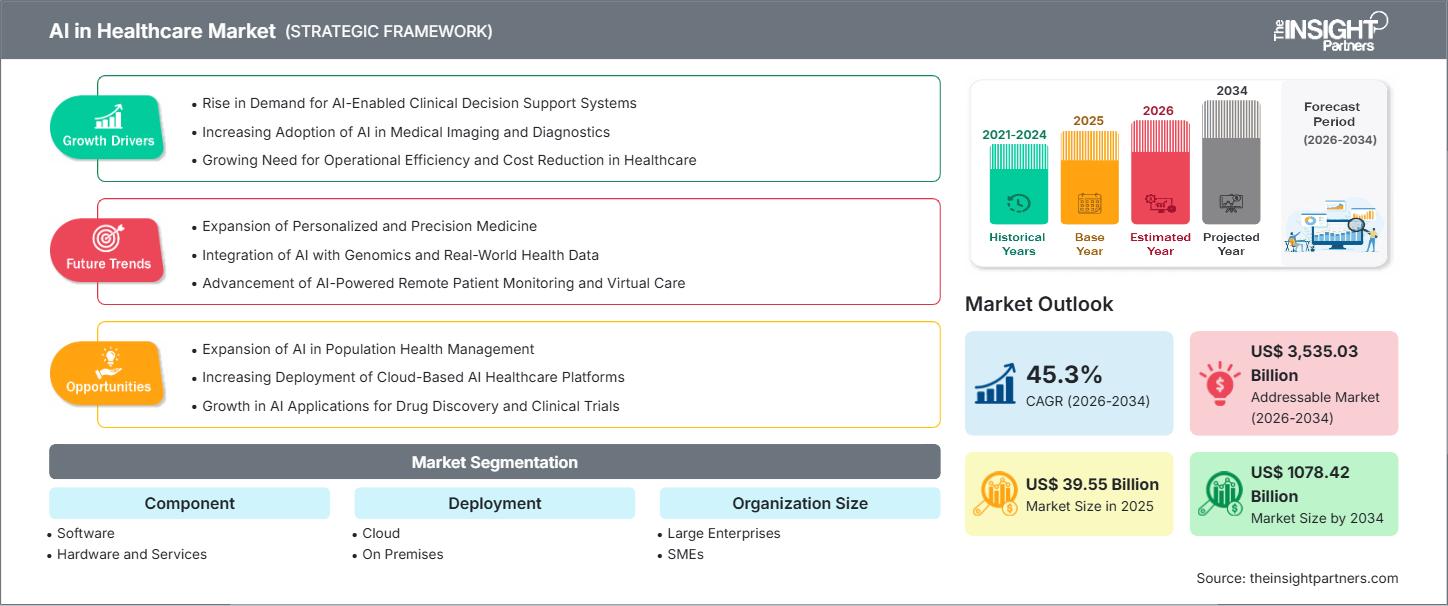
Key Market Findings
- Regional Leader: North America is forecast to account for over 42.92% of global market share by 2034, led by the US and Canada.
- Europe: Europe holds the second-largest share at over 26.83%, with the United Kingdom market projected to grow at a 44.3% CAGR through 2034.
- Dominant Segment: Software and cloud segment retains the largest product segment share.
- Fastest-Growing Segment: Large enterprises registers the fastest CAGR at 45.9%, driven by increasing urbanization, rising patient density in metropolitan hospitals, and the growing need to reduce operational bottlenecks in complex healthcare systems.
Primary Growth Driver: Increasing Volume of Healthcare Data and Need for Advanced Analytics
The exponential growth of healthcare data is a key driver accelerating the adoption of the AI in healthcare market. Electronic health records, medical imaging, genomic data, wearable devices, and remote monitoring tools generate vast volumes of structured and unstructured data daily. Traditional data processing methods are insufficient to extract meaningful insights at scale, creating demand for AI-powered analytics solutions. Machine learning algorithms can analyze complex datasets rapidly, identifying patterns, correlations, and risk factors that support clinical decision-making. AI enhances diagnostic accuracy in radiology, pathology, and cardiology by interpreting imaging data with high precision. In addition, advanced analytics support personalized medicine by tailoring treatment plans based on individual patient profiles and genetic information.
Large Enterprises: A High-Value End-Market
Large healthcare enterprises, including hospitals, pharmaceutical companies, and research institutions, are increasingly adopting AI technologies to automate complex operations such as medical imaging analysis, predictive diagnostics, patient monitoring, and clinical research. These organizations leverage AI tools such as machine learning models, NLP-based clinical documentation, predictive analytics, and virtual health assistants to process large volumes of patient and operational data with high accuracy.
AI enables large healthcare organizations to optimize resource utilization, reduce operational costs, improve patient outcomes, and deliver personalized healthcare services at scale. The scalability, security, and advanced capabilities of AI solutions make them particularly valuable for multinational hospitals, healthcare networks, and pharmaceutical research organizations.
Segment Analysis
Cloud - Market-Leading Product Segment
Cloud-based AI software is witnessing strong adoption in the healthcare sector due to its scalability, cost efficiency, rapid deployment, and accessibility. Cloud platforms enable healthcare providers to process large volumes of patient records, medical imaging data, and research datasets, train AI models, and deploy AI-driven services such as telemedicine solutions, predictive diagnostics, and personalized treatment plans. These platforms allow healthcare organizations to scale computing resources during periods of high demand while reducing capital expenditure.
Leading technology providers such as SAP SE, Google LLC, and Microsoft are actively developing cloud-based AI platforms tailored for healthcare use cases, enabling hospitals, pharmaceutical firms, and research institutions to enhance patient outcomes, improve operational efficiency, and comply with regulatory requirements. Cloud-based AI solutions support faster innovation, streamlined collaboration, and reduced operational costs, making them attractive for healthcare organizations pursuing digital transformation.
Software- Fastest-Growing at 46.7% CAGR
AI software in the healthcare market enables hospitals, clinics, pharmaceutical companies, and research institutions to manage, analyze, and extract insights from vast volumes of clinical, operational, and patient-generated data. These software solutions include machine learning platforms, natural language processing (NLP) tools, computer vision applications, AI-based analytics software, and automation platforms. AI software supports critical healthcare functions such as disease diagnosis, predictive analytics, treatment recommendation, patient monitoring, resource allocation, medical imaging analysis, and regulatory compliance.
Get a customized report to align these insights with your strategic business objectives: https://www.theinsightpartners.com/customization/TIPRE00042231
Regional Analysis
North America - Largest Market
North America dominates the AI in Healthcare market, driven by advanced healthcare infrastructure, high digital health adoption, and significant investments in artificial intelligence and data analytics. The US is the primary contributor, supported by leading healthcare providers, life sciences companies, medical device manufacturers, and technology firms. AI is widely applied across medical imaging, clinical decision support, predictive analytics, virtual health assistants, drug discovery, and personalized medicine.
Europe - Sustained by Government Initiatives
Europe represents a mature and steadily expanding market for AI in Healthcare, driven by public healthcare systems, strong research capabilities, and increasing emphasis on efficiency and patient outcomes. Key markets include Germany, the UK, France, and the Nordic countries, where AI adoption is gaining traction in medical imaging, diagnostics, clinical workflow optimization, and drug development.
Market Dynamics: Key Opportunities and Challenges
Rising Demand for Cost Efficiency and Operational Optimization: The pressure on healthcare systems to reduce operational costs while maintaining quality of care is growing globally. Hospitals, payers, and providers face rising expenses from labor shortages, chronic disease prevalence, and administrative inefficiencies. AI-enabled solutions help automate repetitive tasks such as scheduling, billing, claims processing, and medical coding, reducing overhead costs. Advanced analytics and predictive modeling improve resource allocation by forecasting patient volumes, optimizing staffing levels, and minimizing equipment downtime. AI-driven clinical decision support systems assist clinicians in reducing diagnostic errors and unnecessary procedures, which lowers treatment costs and improves outcomes. Additionally, population health management platforms powered by AI enable early intervention and preventive care, reducing long-term financial burden. As value-based care models gain traction, healthcare organizations rely on AI to track performance metrics, improve patient outcomes, and avoid financial penalties. The ability of AI to deliver measurable cost savings, operational transparency, and scalable efficiency makes it a critical enabler for sustainable healthcare delivery. Consequently, healthcare stakeholders are prioritizing AI investments to achieve financial resilience while meeting regulatory and patient care expectations in competitive markets.
Growth of Remote Care and Virtual Health Models: The expansion of remote care and virtual health services creates substantial opportunities for AI adoption in healthcare. Telemedicine, remote patient monitoring, and virtual diagnostics are becoming integral to modern care delivery models. AI enhances these services by enabling real-time monitoring, automated triage, and predictive alerts for patient deterioration. Wearable devices and connected sensors generate continuous data streams that AI algorithms analyze to detect anomalies and recommend interventions. Virtual assistants and chatbots improve patient engagement by providing symptom assessment, medication reminders, and appointment scheduling. AI-driven triage systems optimize clinician workload by prioritizing high-risk cases. For healthcare providers, remote care supported by AI improves access, reduces hospital readmissions, and lowers operational costs. Payers benefit from improved population health management and reduced claims expenses. As patients prefer convenient, digital-first care experiences, AI-powered virtual health platforms gain competitive relevance. Regulatory acceptance and reimbursement policies for the telehealth support market growth. This convergence of AI and remote care enables scalable, patient-centered healthcare delivery, presenting long-term commercial opportunities for technology vendors and healthcare organizations.
Purchase the full report from The Insight Partners upto 40% Discounted Price - https://www.theinsightpartners.com/buy/TIPRE00042231/
Recent Industry Developments (2025 - 2026)
Accenture has introduced a suite of new services aimed generative AI
In December 2025, Accenture has introduced a suite of new services aimed at enabling companies to tailor and scale the value of generative AI. “Generative AI is accelerating reinvention and delivering value to our clients’ businesses faster.
Amazon Restructures AI Leadership to Integrate Models, Chips, and Quantum Computing
In March 2025, Amazon is reorganizing its artificial intelligence team, with a long-standing veteran leaving and another leader stepping in to oversee a larger unit that now encompasses AI models, custom chips, and quantum computing. This change comes just two weeks after Amazon Web Services held its annual cloud computing conference in Las Vegas, which the company has increasingly used to highlight its AI tools and services.
Leading AI in Healthcare Companies
| Company | Profile |
| Accenture Plc | Global professional services firm providing AI-driven healthcare consulting, digital transformation, and cloud-based clinical workflow solutions for hospitals and life sciences companies. |
| Advanced Micro Devices Inc. | Semiconductor company supplying high-performance computing hardware and GPUs used in AI-powered healthcare imaging, diagnostics, and genomics processing. |
| Google LLC | Developer of AI healthcare solutions through Google Health and DeepMind, focusing on medical imaging, predictive diagnostics, and large-scale health data analytics. |
| International Business Machines Corp. | IBM leverages Watson Health and AI platforms for clinical decision support, drug discovery, and enterprise healthcare data management solutions. |
| Intel Corp. | Provides processors, edge AI solutions, and healthcare analytics infrastructure enabling real-time diagnostics, medical imaging, and hospital automation systems. |
| Microsoft Corp. | Offers AI-powered healthcare cloud services via Azure, enabling predictive analytics, electronic health records integration, and intelligent clinical decision support tools. |
| NVIDIA Corp. | Leading provider of AI computing platforms and GPUs widely used in medical imaging, drug discovery, genomics, and AI model training in healthcare. |
| Amazon Web Services Inc. | Provides scalable cloud infrastructure and AI/ML services for healthcare analytics, clinical data management, telehealth platforms, and AI-driven diagnostics. |
| SAP SE | Enterprise software company delivering AI-enabled healthcare ERP, patient data management systems, and predictive analytics for hospital operations and supply chains. |
| SAS Institute Inc, | The company provides its flagship AI and Analytics platform along with specialized solutions to process complex and fragmented data. |
About The Insight Partners
The Insight Partners is a globally recognized market research and management consulting firm specializing in technology, media, telecommunications, healthcare, and industrial sectors. Research methodology integrates primary data collection including executive interviews, OEM surveys, and channel partner analyses with proprietary secondary research databases and econometric modeling. Reports are used by Fortune 500 companies, private equity firms, government agencies, and institutional investors to inform strategic planning, M&A, and capital allocation decisions. The firm maintains research coverage across 50+ industries and 100+ countries.
Press Release: https://www.theinsightpartners.com/pr/ai-in-healthcare-market
Request for a free demo of The Insight Partners’ AI in Healthcare Market & Intelligence Platform
Media Contact: The Insight Partners | sales@theinsightpartners.com | www.theinsightpartners.com


Legal Disclaimer:
EIN Presswire provides this news content "as is" without warranty of any kind. We do not accept any responsibility or liability for the accuracy, content, images, videos, licenses, completeness, legality, or reliability of the information contained in this article. If you have any complaints or copyright issues related to this article, kindly contact the author above.
